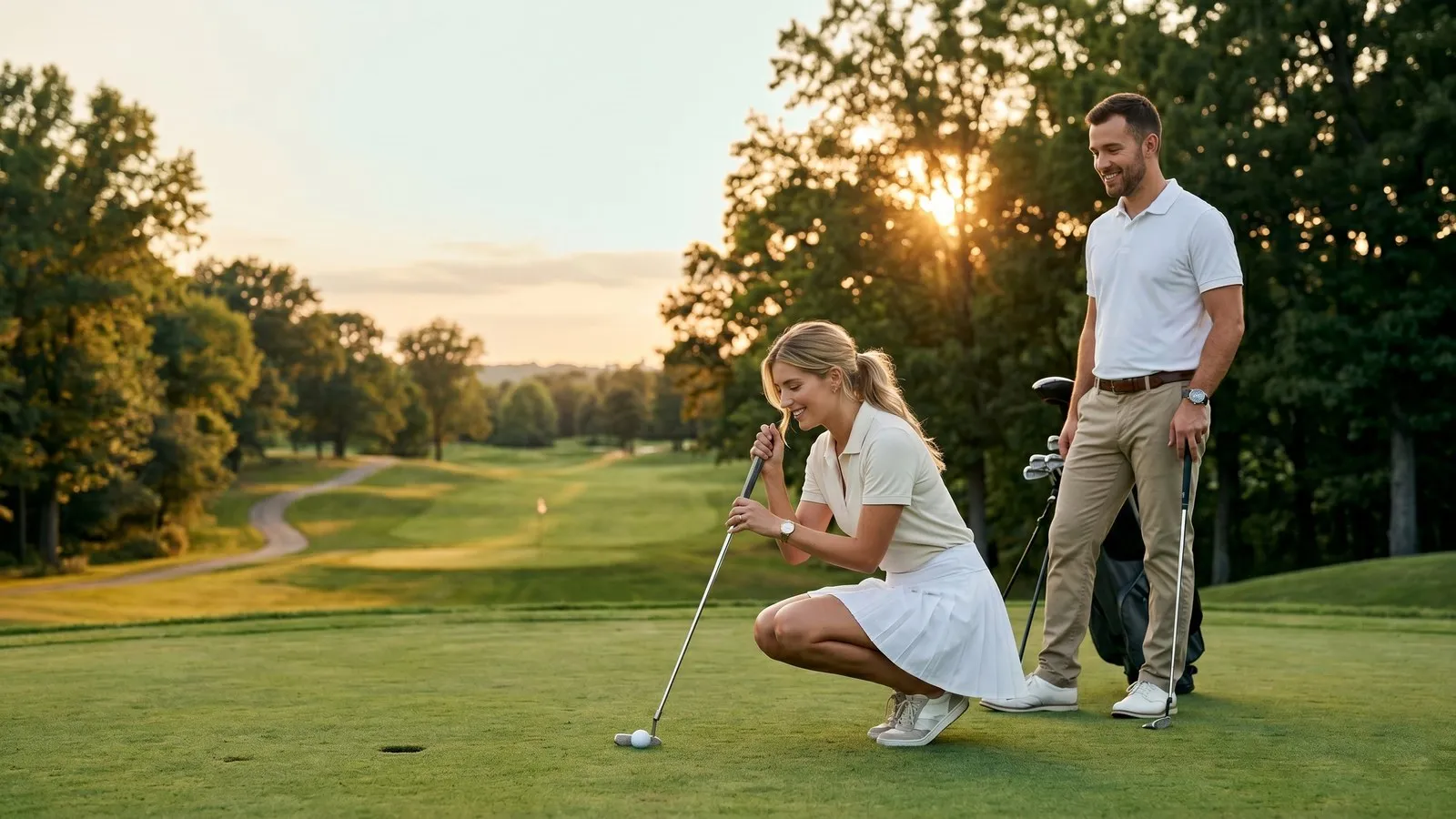
Why golfers make better partners — the data behind the cliché
'Date a golfer — they have the patience for anything.' The cliche is everywhere, but it's mostly delivered by people who already love the game. We checked whether any of it holds up against the data.
You’ve probably heard some version of it. “Date a golfer — they have the patience for anything.” “Golfers are great partners because they’re outside all day.” The cliché writes itself, but it’s mostly delivered by people who already love the game. We wanted to know if any of it actually holds up — so we looked at the data.
TL;DR
- Golfers spend ~4 hours per round outdoors and walk roughly 5 miles — health and patience are not just personality claims
- US active golfers skew higher-income, with a median household income above the US median (NGF, 2024)
- Women now make up 26% of US golfers and 39% of new players — the dating pool is shifting fast
- The “shared activity” effect is real: couples with overlapping hobbies report higher relationship satisfaction in long-term studies
- Where the cliché falls apart: time commitment, equipment cost, and the “golf widow” risk
The patience claim — actually defensible
A typical 18-hole round in the US takes 4 to 4.5 hours — pace of play is enough of a perennial issue that the USGA runs a whole Pace of Play Resource Center on it. During that time a golfer:
- Hits roughly 80–100 shots (depending on skill)
- Walks (or rides) about 5 miles
- Loses one or two balls and has to laugh it off
- Watches three other people hit shots that aren’t theirs
- Stands still for 30+ seconds between turns, repeatedly
Think about what that requires. Hitting a shot you’d rather take back, then doing it again 50 yards later. Watching someone slice their drive into the trees and saying “we’ll find it.” Following a routine when your last shot was the worst of your life. Patience isn’t a personality trait golfers self-report — it’s something the game forces on them every weekend.
The partner translation is direct: someone who can recover gracefully from a bad shot can recover gracefully from a bad day at work. Someone who waits their turn on the tee can wait their turn in a conversation.
The outdoor + activity claim — also defensible
The NGF reports that the average US golfer plays 18 rounds a year. At ~5 miles per round walked, that’s roughly 90 miles of walking per year just from golf. For comparison, the CDC recommends 150 minutes of moderate activity per week — a 4-hour round demolishes that single-handedly.
This is a quietly underrated dating signal. Golfers who play regularly already have a baseline of:
- Sunday morning routines that don’t involve being hungover
- Friendships built on shared activity, not shared bar tabs
- A reason to be outside, repeatedly, for years
Compare to someone whose primary recurring social activity is “going to brunch.” Not a knock on brunch — but four hours of brunch, twice a week, isn’t a lifestyle that ages especially well into your 40s.
The shared-hobby effect (this is the big one)
A meta-review of relationship satisfaction studies summarized in Pew’s research on couples repeatedly finds that couples with overlapping leisure activities report higher long-term satisfaction than couples whose hobbies don’t intersect. The mechanism is partly time spent together — but more interestingly, the quality of that time. Doing something side-by-side that requires actual engagement (not just sitting next to each other watching Netflix) creates more conversation, more shared memory, and more small problem-solving moments.
Golf is unusually good at this because:
- It’s long enough to talk. Four hours together produces real conversation, not surface-level chitchat.
- It’s not too cooperative. Unlike tennis doubles, you’re not constantly relying on each other — so it doesn’t generate the friction that competitive partner sports do.
- There’s downtime. Walking between shots, waiting on the tee, riding in a cart together — those are conversation slots that don’t exist in most other activities.
- It travels. Couples who play together vacation differently. A golf trip is a vacation built around doing something together every day, not lying next to each other on a beach.
Where the cliché falls apart
To be fair to the skeptics:
Time cost
A round costs 4–5 hours plus travel. If one partner plays and the other doesn’t, that’s a meaningful weekly tax on shared time. The classic “golf widow” or “golf widower” phenomenon is real — and it’s the leading cause of the cliché working against golfers in dating bios.
The fix is either both partners play, or the playing partner negotiates a clear weekly cadence (e.g. one Saturday morning of golf, the rest of the weekend together). This is genuinely an issue that doesn’t exist for most other hobbies.
Equipment cost
A full set of starter clubs runs $400–800. Greens fees average $40–80 for a public weekend round. The PGA’s GOLF 2.0 participation report consistently flags cost as the #1 barrier for new players, especially women. Couples who both play often subsidize the lower-frequency player’s gear, which is a financial decision worth being honest about.
The “golf bro” subculture
Yes, it exists. The combination of country club pricing and Saturday morning availability does produce a recognizable type — middle-aged, opinion-heavy, brand-loyal to Titleist. That type isn’t the entire golf community, but it’s the loudest part on Twitter. Anyone dating into golf has to recognize the difference between someone who loves the game and someone who loves the costume.
The demographic shift — why this matters in 2026
Until about 2018, the US golfer was reliably male, mid-40s, and married. That’s changed fast.
- Women golfers: 26% of all US golfers in 2024 (NGF), up from 19% in 2016
- New golfers: 39% of new players in 2023 were women (NGF)
- Off-course golfers (Topgolf, simulators, ranges): 41 million Americans — half are under 35
- 20–34 year-olds are the fastest-growing golfer demographic by participation rate
Translation: if you’re a single golfer in your 20s or 30s, the population of single golfers who could realistically match you is the largest it’s been in your lifetime — and growing every year. The “no one my age plays” objection is rapidly becoming false.
So: is the cliché true?
Yes, with caveats. Golfers do tend to have above-average patience, above-average outdoor time, above-average shared-activity infrastructure, and above-average household income. They also have above-average time commitment, equipment cost, and a real but solvable “golf widow” problem.
The cliché holds because the activity itself shapes the people who do it. Spend 90 hours a year walking, waiting, recovering from bad shots, and laughing about it — and you become someone who does that elsewhere in life too. Whether that’s an attractive thing in a partner depends entirely on whether you find those traits attractive in a partner. (We do.)
If you’re a golfer who’d rather not explain “why golf?” on a first date, Golfmatch is the dating app where every match already plays. Match by handicap, calendar, and home course — then meet on the first tee.